
-
-
-
-
-
-
-
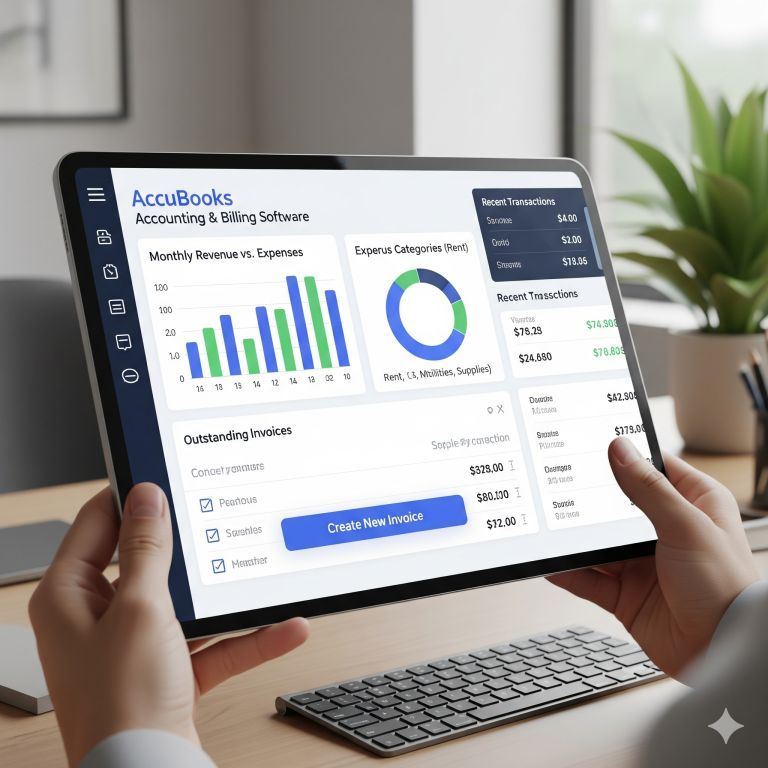
Accounting & Billing Software

Jaipur, Rajasthan, India
From automated invoicing and expense tracking to tax compliance and balance sheet management, our tools are designed to simplify your accounting workflows, enhance accuracy, and ensure timely billing.
Quantity & Pricing
| Quantity Range | Unit Type | Price Range |
|---|---|---|
| 0-100 | piece | 80000 |
Shipping Information
Exporter details revealed after verified importer registration
Custom accounting and billing software covers invoicing engines, GST and tax compliance modules, multi-currency ledgers, payment reconciliation tools, and reporting dashboards built to match how a specific business actually operates, rather than how a generic accounting package assumes it should. India's own accounting software market is valued at roughly USD 16.5 billion in 2025 and growing past USD 30 billion by 2032, and that domestic scale is part of why Indian development teams building this software for international clients also understand the compliance weight of the category, not just the UI. Custom software development out of India runs USD 15 to 45 per developer hour depending on seniority, against USD 150 to 200 for equivalent US or UK development, a cost gap wide enough to change what's worth building custom versus buying off the shelf.
| Module / Feature | Details |
|---|---|
| Invoicing Engine | Recurring and one-time invoices, multi-currency support, custom templates, automated numbering and tax calculation |
| GST and Tax Compliance | E-invoice generation with IRN and QR code, GSTR filing support, e-way bill integration, HSN/SAC code mapping |
| Accounts Receivable/Payable | Payment tracking, automated reminders, aging reports, vendor and customer ledgers |
| Bank Reconciliation | Bank feed integration, auto-matching transactions, discrepancy flagging |
| Multi-Entity Support | Consolidated reporting across multiple business units, branches, or subsidiaries |
| Payment Gateway Integration | Razorpay, Stripe, PayPal, and local payment rail integrations by market |
| Reporting and Analytics | P&L, balance sheet, cash flow statements, custom report builder, dashboard views |
| User Roles and Permissions | Role-based access for accountants, approvers, viewers, and admins |
| Integrations | ERP systems (SAP, Oracle), e-commerce platforms, payroll software, third-party APIs |
| Mobile App | iOS/Android for invoice creation, expense capture, and approval workflows on the go |
| Audit Trail | Full change logs for every transaction, required for compliance and dispute resolution |
Off-the-shelf tools like QuickBooks, Xero, Zoho Books, and Tally handle standard bookkeeping well, and for most businesses, that's the right call. Custom development starts making sense when a business's invoicing or tax situation is specific enough that the generic tool needs constant workarounds. In India, GST e-invoicing is the clearest trigger right now. Since 2023, businesses crossing 5 crore rupees in turnover must generate e-invoices with a government-issued IRN and QR code on every B2B and export transaction, and since April 2025, businesses above 10 crore have to report those invoices to the government portal within 30 days. Off-the-shelf tools handle the basic version of this, but businesses with multi-entity structures, unusual tax treatments, or high-volume job-work billing often find themselves building spreadsheet patches around the software rather than trusting it outright. Outside GST specifically, the other common triggers are multi-currency operations that a domestic tool wasn't built for, integration with a proprietary ERP or e-commerce platform, and industry-specific billing logic like subscription tiers, usage-based pricing, or milestone billing that standard invoicing fields can't represent cleanly.
It's worth saying plainly: most businesses don't need custom software, and building it when a configured version of Xero or Zoho Books would do the job is just an expensive way to reinvent something that already works. The honest question isn't whether custom sounds more impressive, it's whether your team is spending more time fighting the limitations of an off-the-shelf tool than a custom build would cost to create and maintain.
Indian developers building accounting and billing software bill USD 15 to 45 per hour depending on seniority and stack. A mid-scale accounting platform covering core invoicing, GST compliance, reconciliation, and reporting typically runs USD 40,000 to 90,000 with an Indian team, against several times that with a US or UK agency for the same scope. The part that matters beyond price: India's own GST regime is one of the more procedurally demanding tax compliance systems in the world, with invoice-level government reporting, e-way bills, and shifting turnover thresholds that teams building for the domestic market have to get exactly right or face penalties. Teams with that production experience bring a different level of rigor to compliance logic than teams who've only ever built invoicing for markets with simpler tax reporting.
Ask to see a live accounting or billing system they've built handling a compliance requirement similar to yours, and talk to the finance team using it day to day, not just the person who commissioned it. Ask specifically how the team handles compliance updates after launch. Tax rules change, and a system that needs a full development sprint every time a government portal changes its API is going to cost you more in the second year than the first. Confirm data handling in the contract: accounting software holds bank details, transaction history, and tax filings, so encryption, access control, audit logging, and what happens to your data if the vendor relationship ends all need to be spelled out rather than assumed.
Fixed-price for a clearly scoped module like an invoicing engine or GST compliance add-on. Time-and-material for integrations or builds where requirements are likely to shift during discovery. Dedicated development team for ongoing product development. Monthly retainer for post-launch maintenance and compliance updates as tax rules change.
Backend: Node.js, Python (Django/FastAPI), Laravel, .NET. Frontend: React, Angular, Vue.js. Mobile: React Native, Flutter. Database: PostgreSQL, MySQL. Cloud: AWS, Azure. Integrations: REST APIs, GST Invoice Registration Portal (IRP), payment gateways, banking APIs for reconciliation. Stack recommendation depends on your existing infrastructure and what your team can maintain after handoff.
Most businesses are better off with a configured off-the-shelf tool. Custom starts making sense when your invoicing or compliance needs are specific enough that the generic tool needs constant workarounds, like multi-entity consolidation, unusual billing models such as usage-based or milestone pricing, or GST e-invoicing at a volume and complexity the standard integration doesn't handle cleanly. If your team spends more time patching around software limitations than a custom build would cost to create, that's the signal.
Businesses above 5 crore rupees turnover must generate invoices with a government-issued Invoice Reference Number and QR code through the Invoice Registration Portal, and businesses above 10 crore must report those invoices within 30 days. The software needs to talk directly to that portal in real time, not just print an invoice that looks compliant.
This is worth asking directly before signing. Tax authorities update thresholds, formats, and reporting rules periodically, and a system built to handle updates through configuration rather than a full re-development cycle each time will cost far less to maintain. Ask for a specific example of how a past compliance change was rolled out to an existing client.
Accounting software holds bank account details, transaction history, and tax filings, so the contract should cover encryption at rest and in transit, role-based access control, and a full audit log of every change made to a record. Also confirm in writing what happens to your data if the vendor relationship ends, since that's often left out of standard development contracts.
A single module like an invoicing engine or GST compliance add-on runs USD 10,000 to 25,000 over 6 to 10 weeks. A mid-scale platform covering invoicing, GST compliance, reconciliation, and reporting runs USD 40,000 to 90,000 over 16 to 24 weeks. A full-suite platform with multi-entity support, ERP integration, and a mobile app runs USD 90,000 or more over 6 to 10 months. Integration work with existing ERP or payment systems is a separate cost item that's easy to underestimate at the proposal stage.
Connect with EXP01002 and thousands of verified Indian exporters on Navi Exports