-
-
-
-
-
-
-
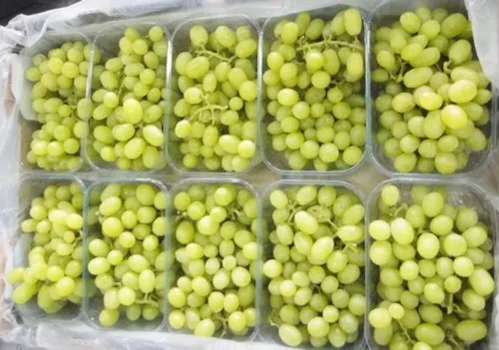
Fresh Grapes Exporter 4.5kg Carton Premium Europe
Chennai, Tamil Nadu, India
Fresh grapes exporter 4.5kg carton premium Europe supplying export-packed premium grapes with cold chain support.
Shipping Information
Exporter details revealed after verified importer registration
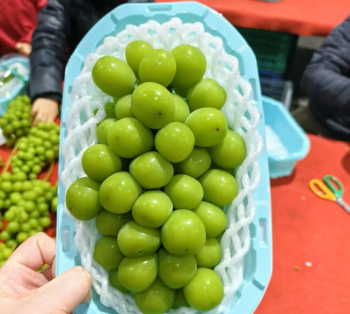
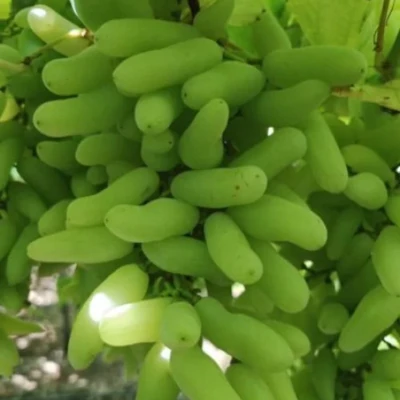
Fresh green grapes (Vitis vinifera, Thompson Seedless variety) packed in the 4.5kg premium export carton and shipped to Europe require a different handling approach than nearer Gulf-bound shipments, given the longer 20-30 day sea transit most bulk grape exports to European ports involve. The variety is grown almost entirely in Nashik, Maharashtra, supported by decades of grading and cold storage infrastructure built specifically around export-grade table grape production for distant markets including the EU. Operating from Chennai as a trading and export coordination base, we source Thompson Seedless directly from Nashik growers and manage the specific packing, SO2 treatment, and documentation European import requires. For EU importers and specialty retail distributors, this offers India's flagship export grape variety with premium grading suited to the region's longer transit demands.
| Attribute | Details / Value |
|---|---|
| Botanical Name | Vitis vinifera, Thompson Seedless cultivar |
| Growing Region | Nashik, Maharashtra |
| Grade | Premium / Grade A, hand-sorted |
| Carton Weight | 4.5kg, standard premium export specification |
| Berry Size | 18-20mm diameter, larger sizes available on request |
| Color | Light green to golden-green, uniform |
| Bunch Weight | 300-500g per bunch, compact and well-filled |
| Brix (Sugar Content) | Minimum 16-18 degrees Brix |
| Firmness | Firm berries, well-attached to stem, no shattering |
| Pesticide Residue | Within MRL limits for EU food import regulations (Reg. 396/2005) |
| Shelf Life | 4-5 weeks under continuous cold chain with SO2 treatment for extended EU transit |
| Storage Condition | 0-1°C, 90-95% relative humidity |
| Harvest Season | January to April (Nashik peak export season) |
| HS Code | 0806.10.00 (fresh grapes), confirm with CHA |
Grapes headed to Europe's 20-30 day sea transit need sulfur dioxide (SO2) generating pads within the packaging to control decay, particularly Botrytis mold, that shorter Gulf-bound shipments generally don't require to the same degree. This treatment is standard practice for Indian grape exporters supplying distant markets, and buyers should confirm it's included rather than assuming standard packing covers it.
EU pesticide residue limits under Regulation 396/2005 are generally stricter and more actively enforced than GCC requirements, and grapes specifically face closer scrutiny given the multiple spray cycles typical during cultivation. Buyers should confirm the exporter tests against current EU MRL thresholds specifically, rather than a generic pesticide residue report, before the first shipment.
Nashik sits on India's western side, a considerable distance from Chennai, so our role here is trading, quality grading, and export documentation rather than proximity to the vineyards, Mumbai's JNPT is the more geographically direct port most grape exporters use for European shipments. What Chennai offers is established export coordination for buyers consolidating grape orders alongside other South Indian export categories. Buyers prioritizing the most direct routing for grapes specifically to Europe may find Mumbai-based export offers a shorter path.
4.5kg vented plastic clamshells or perforated punnets with SO2-generating pads for extended EU transit. Individual bunch cushioning to prevent berry shatter. Master cartons palletized specifically for the airflow patterns reefer containers need to maintain even temperature across a 20-30 day voyage.
Phytosanitary certificate from India's Plant Quarantine Department for every shipment, Certificate of Origin, pesticide residue test reports confirming EU MRL compliance specifically, APEDA registration.
Europe's 20-30 day sea transit is considerably longer than Gulf-bound shipments, and sulfur dioxide (SO2) generating pads within the packaging control decay, particularly Botrytis mold, over that extended period. This is standard practice for Indian grape exporters supplying distant markets and should be confirmed as included rather than assumed.
EU limits under Regulation 396/2005 are generally more strictly enforced than GCC requirements, and grapes face particular scrutiny given typical cultivation spray cycles. Buyers should confirm the exporter tests specifically against current EU MRL thresholds rather than relying on a generic residue report.
Sea freight from Indian ports to major EU destinations like Rotterdam or Hamburg typically takes 20-30 days under continuous reefer container conditions with SO2 treatment maintaining fruit quality throughout the voyage.
Trial orders typically start at 500kg, with full-container bulk orders at 1 FCL, roughly 18-20 metric tons in a reefer container. Availability depends on Nashik's January-to-April harvest cycle.
Fresh grapes are classified under HS code 0806.10.00. EU CN codes extend this classification further for customs filing, so confirm the exact code and any EU-specific documentation requirements with your customs broker before the first shipment.
Connect with EXP01002 and thousands of verified Indian exporters on Navi Exports